What it is
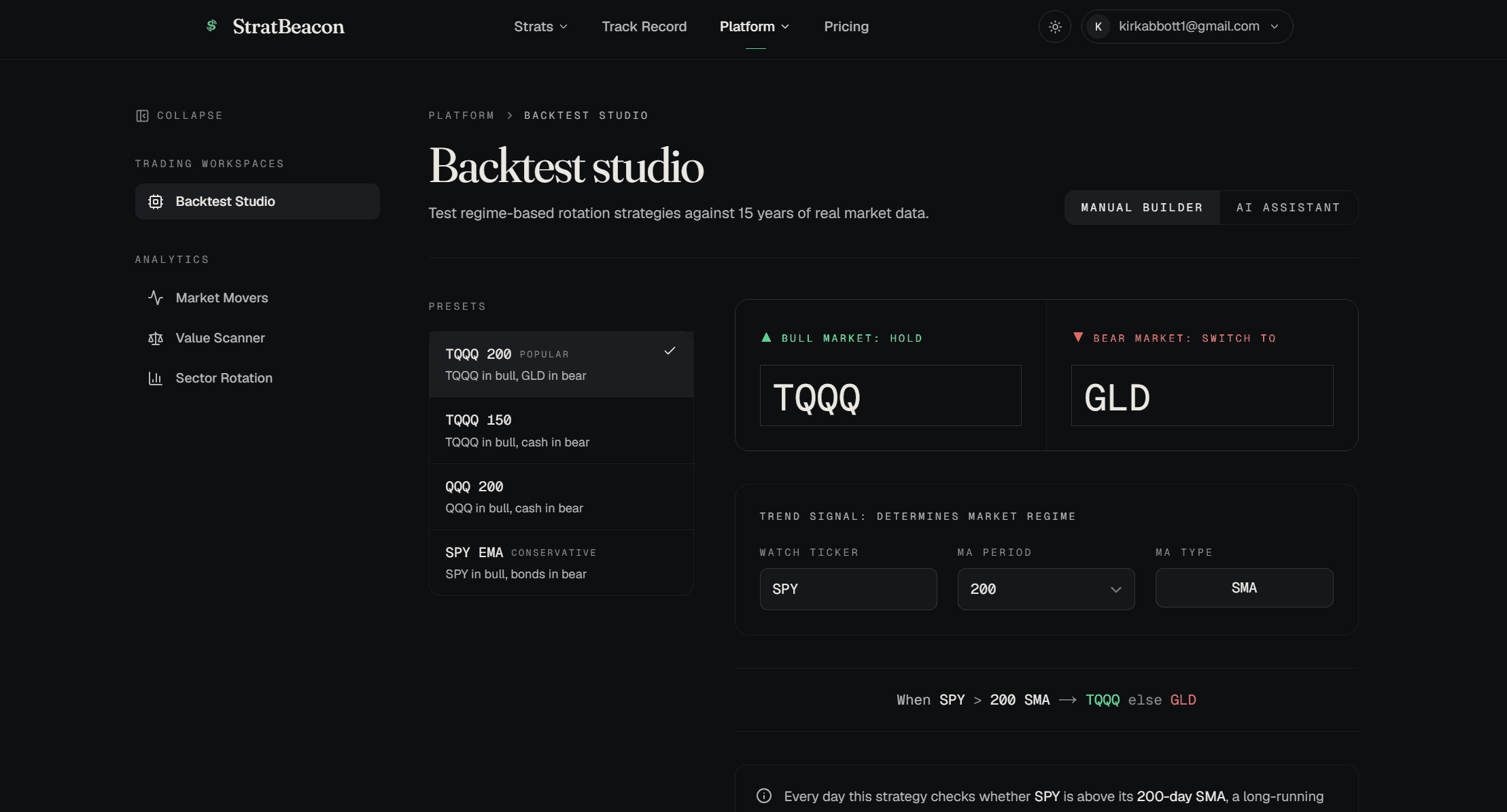
Stratbeacon delivers timing signals for leveraged-ETF and options-based strategies to retail traders. Subscribers get alerts when the underlying market state crosses thresholds their chosen strategy reacts to.
Stack
- Frontend: Next.js with NextAuth-backed sessions
- Backend: Python / FastAPI; PostgreSQL accessed through Prisma (Node side) and SQLAlchemy (Python side)
- Financial data: Schwab API integration for live quotes, account state, and order placement
- Payments: Stripe subscriptions and billing
- Automation: n8n for workflow orchestration; background scheduler for strategy alerts
- Content: Ghost CMS for the marketing blog
- Infra: Self-hosted on a VPS via Coolify
Security
Financial applications have real security requirements: encrypted user OAuth tokens at rest, cross-stack session authentication, internal-endpoint protection against timing attacks, safety-critical input validation. Some of the techniques shipped on Stratbeacon are written up on this site:
- Per-user OAuth token encryption with HKDF key derivation, a fix that replaced a length-extension-vulnerable
SHA256(master || user_id)pattern. See “Per-user encryption keys: a length-extension trap and the HKDF fix”. - NextAuth JWE session decryption in the Python backend, so a Next.js frontend can hand off authenticated requests to a FastAPI service without a parallel auth stack.
- Internal-API endpoints (called by n8n) protected with
secrets.compare_digestshared-secret comparison, timing-attack safe. - Pydantic input validation with explicit per-field risk documentation for safety-critical trading parameters (level spacing, allocation factors, price bounds).
- A documented accepted-risk register so the deferred work is visible.
What it's taught me
Operating a real product has a different texture than shipping experiments: the failure modes are real, the security stakes are real, and the design decisions persist. A lot of what I write about cloud and security on this site comes from the things Stratbeacon makes me figure out.